
How School Choice Changed Sam Myers’ Life and Opened Doors for Thousands More
When a doctor said Sam Myers would be a burden, his family refused to accept it — and spent eight years changing the system.
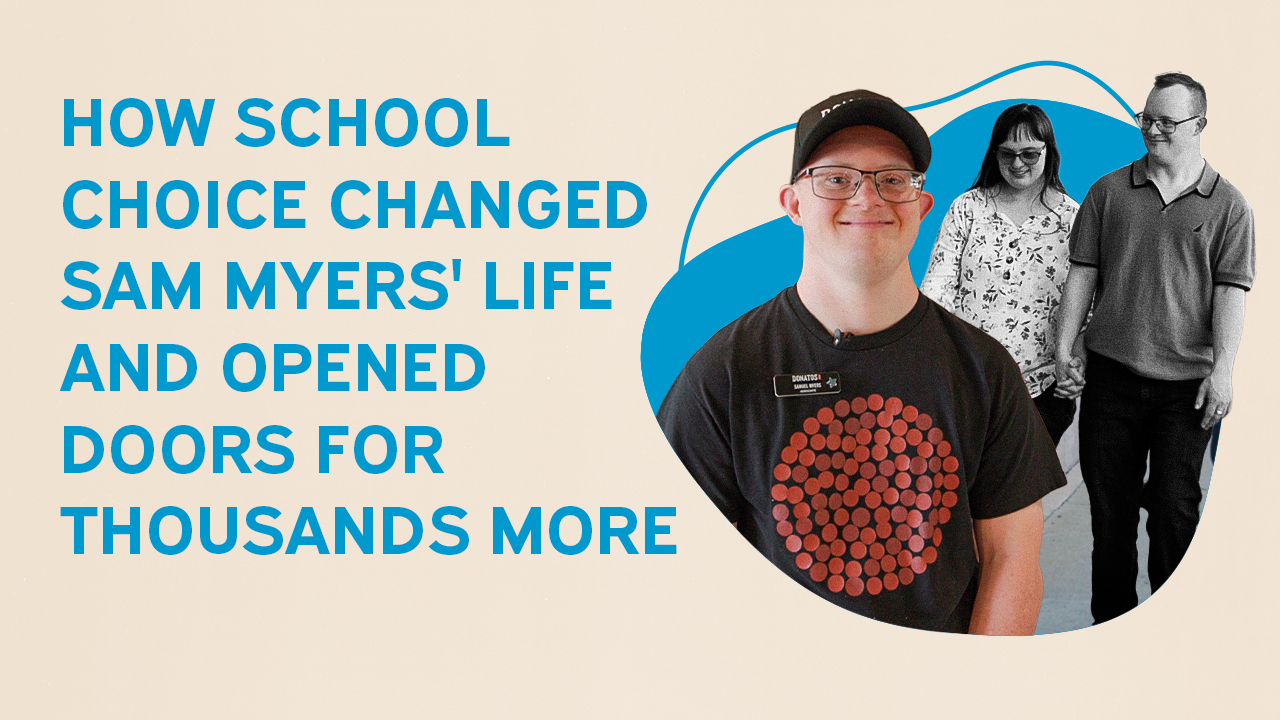

Samuel Myers works two jobs. He has a girlfriend. He started his own card-making business. He even met the President. But more than 30 years ago, none of this seemed possible.
After learning that their son had Down syndrome, their doctor painted a grim picture — warning that their child would face significant limitations and become a burden on their family, their church, and their community.
Tera and Lew refused to accept that prediction.
“We chose Samuel because it was a biblical name, and it meant ‘asked of God,'” Tera recalled. “We really felt like we were being asked for something special.”
When the System Said No
As Sam grew older, his parents quickly realized that finding the right educational environment would not be easy.
The challenge? A system that offered little flexibility for families seeking something different for their children.
When the Myers family approached school officials about redirecting resources so Sam could access educational opportunities that better met his needs, they were told that the district controlled the funding. If they wanted something different, they would have to find a way to make it happen on their own.
Rather than accepting that answer, Tera and Lew decided to fight for change.
Their belief was simple: funding intended for a child’s education should follow that child to the learning environment where he or she could thrive.
An Eight-Year Fight for Education Freedom
What followed was an eight-year journey that would ultimately change the lives of thousands of families.
While homeschooling Sam and his sisters, Tera became a leading advocate for educational opportunity for students with special needs. She spent years traveling to Columbus, often sitting through daylong legislative hearings for the opportunity to speak for just a few minutes.
The effort was filled with setbacks. Legislation creating a scholarship program for students with special needs was vetoed twice. Many families would have given up.
The Myers family did not.
On one particularly emotional day, Tera waited from morning until nearly midnight for the opportunity to testify before lawmakers. When her turn finally came, she held up a picture of her son and made a simple plea.
“I need you to pass this,” she told them. “He’s counting on you to make a decision for him and children like him.” Sam stood beside her throughout the process.
After one testimony, as Tera stepped away from the podium, Sam leaned over and quietly said, “Mom, good job.” The moment left an impression on all the legislators.
“I need you to pass this. He’s counting on you to make a decision for him and children like him.”
Finally, in June 2011, after years of advocacy, Ohio enacted the Jon Peterson Special Needs Scholarship Program. Sam became one of the first scholarship recipients in the state.
A School Where Sam Could Thrive
The scholarship gave Sam something every child deserves: access to a school that could meet his unique needs and help him reach his potential.
He embraced the opportunity wholeheartedly.
According to his family, Sam loved school so much that snow days were often a source of disappointment. While other students celebrated cancellations, Sam hoped the phone wouldn’t ring with news that classes had been called off.
At his new school, he developed critical academic and life skills that would prepare him for adulthood.
“I learned many skills,” Sam said. “Reading, math, and writing.”
He also gained confidence, independence, and the opportunity to build a future that reflected his abilities rather than the assumptions others had made about him.
Get notified when the Education Freedom Tax Credit launches so you don’t miss the opportunity to support K–12 students while benefiting from a federal tax credit.
The Return on an Investment of School Choice
When people ask Tera why she devoted nearly a decade of her life to passing a scholarship program, her answer has never been solely about her son. She viewed the fight as a responsibility to the taxpayers and community members who invest in the next generation.
“They weren’t just Samuel’s dollars,” she said. “They were dollars assigned to Samuel from our tax-paying citizens, my neighbors, my coworkers, my friends. I wanted to make sure Mrs. Jones down the street got a really good return on her investment.”
“They weren’t just Samuel’s dollars. They were dollars assigned to Samuel from our tax-paying citizens, my neighbors, my coworkers, my friends.”
More than a decade later, it’s clear she did.
Today, Sam works at Donatos Pizza, where he has been employed for nine years, and at the YMCA, where he has worked for three. He operates a card-making business from his home, creating birthday cards, get-well cards, and messages of encouragement for people throughout his community.
He takes pride in earning money for his future. He votes. He gives back. He looks for ways to serve others.
In 2020, Sam received an invitation from the White House and was recognized for his contributions and achievements. His first reaction wasn’t excitement about the recognition. Instead, he worried about missing work because his coworkers were counting on him.
What the Education Freedom Tax Credit Asks of You
The Myers family’s story is ultimately about more than one student. It is about what becomes possible when families are empowered to choose the educational environment that best fits their children’s needs.
The Jon Peterson Special Needs Scholarship Program helped pave the way for Ohio students with special needs to access educational opportunities that may otherwise have been out of reach. Its success stands as a testament to the power of educational freedom and the determination of parents who refuse to settle for a one-size-fits-all system.

Beginning in 2027, families will have another opportunity to expand educational access through the Education Freedom Tax Credit. The program will allow taxpayers to receive a dollar-for-dollar tax credit for contributions to scholarship-granting organizations, helping create new pathways for students and families seeking the educational environment that works best for them.
For parents searching for the right fit, the Education Freedom Tax Credit represents another step toward ensuring that a child’s future is not determined by a diagnosis, a ZIP code, or a family’s financial circumstances. It reflects a growing belief that educational opportunities should be accessible to every family and that parents should have the freedom to choose the learning environment where their children can thrive.
More than three decades ago, a doctor told Tera and Lew Myers that their son would be a burden on his family and community. Today, Sam’s life tells a very different story.
Through his work, his kindness, and his commitment to serving others, he represents the return that communities receive when they invest in children and trust families to make educational decisions on their behalf.
Tera answered her calling by fighting for Samuel’s future. She spent years fighting for a scholarship program that would allow families to access the educational opportunities their children needed to thrive. Because of her perseverance, thousands of students have had opportunities they may never have received otherwise.
Today, we are asking others to answer a similar call. Just as Tera Myers dedicated herself to securing the best possible education and future for Samuel, we invite you to help do the same for students across the country. Through the support and funding of the Education Freedom Tax Credit, you can help expand access to life-changing educational opportunities for families searching for the right fit for their children.
Disclaimer: This article is for informational and educational purposes only and does not constitute tax, legal, or financial advice. Tax laws are subject to change. Please consult a qualified tax professional regarding your individual circumstances. The Education Freedom Tax Credit is effective January 1, 2027. Contribution limits and program details are subject to IRS guidance and final program rules.