
What Happens After I Donate? Your EFTC Timeline from Gift to Tax Filing
From the moment your check clears to the day the credit posts on your return — here’s the complete, step-by-step EFTC donor timeline.

You’ve heard about the Education Freedom Tax Credit. You’re ready to give. But what happens next? Here’s every step — from writing the check to seeing the credit on your tax return.
The EFTC is a first-of-its-kind federal program that lets individual donors give up to $10,000 to a qualified Scholarship Granting Organization (SGO) and receive powerful tax benefits on both ends. The first $1,700 of your donation qualifies for a 100% federal tax credit — meaning it comes directly off your tax bill, dollar for dollar. Any amount above that, up to $10,000, is treated as a standard charitable deduction for a 501(c)(3) nonprofit, just like any other qualifying gift. But understanding what happens between your donation and your tax filing can make the entire process feel a lot less abstract.
Below is the complete EFTC donor timeline, broken down by season and action.
Step 1: Make Your Donation to a Qualified SGO (Anytime in 2027)
The EFTC goes into effect on January 1, 2027. From that date through December 31, 2027, any donation you make to a federally qualified Scholarship Granting Organization counts toward your EFTC credit for the 2027 tax year.
You can give once or give multiple times throughout the year. The first $1,700 of your total annual SGO donations qualifies for a 100% federal tax credit — a dollar-for-dollar reduction of your tax bill. If you give more than $1,700 (up to $10,000), the additional amount is treated as a standard charitable deduction under the 501(c)(3) rules, the same tax benefit you’d receive for any qualifying nonprofit donation.

When you donate, your SGO will confirm receipt of your contribution. Save that confirmation. It’s the first piece of documentation you’ll need at tax time.
“The first $1,700 you give to a qualified SGO comes straight back off your federal tax bill — dollar for dollar. That’s not a deduction. That’s a credit.”
Step 2: Your Donation Funds a K–12 Student Scholarship (Within Weeks to Months)
After your donation is received, the SGO pools it with contributions from other donors to award scholarships to eligible K–12 students. These scholarships can cover private school tuition, home school curriculum costs, tutoring, and other qualifying educational expenses.
You don’t need to take any action during this phase. The SGO handles the student selection and scholarship disbursement process according to its own criteria and your state’s applicable rules. Most SGOs prioritize students from lower-income families, ensuring the credit reaches those who need it most.
If your SGO has a donor designation policy, you may be notified when a scholarship is awarded in connection with your gift. Otherwise, you’ll receive your formal tax documentation in early 2028.
Step 3: Your SGO Sends Tax Documentation (Early 2028)
In January or February 2028, your SGO will provide the documentation you need to claim your credit. This typically includes:
Keep these documents with your tax records. Your accountant or tax software will need them when you file your 2027 return.
Step 4: Claim Your Federal Tax Credit on Your 2027 Return (January–April 2028)
When you file your federal income taxes for the 2027 tax year — typically between January and April 2028 — you’ll report your qualified SGO donation and claim the Education Freedom Tax Credit.
The credit is applied directly against your federal income tax liability. If your credit exceeds your total tax owed for the year, you may be entitled to a refund for the difference (subject to final IRS refundability rules). Your tax professional can help you determine the maximum benefit based on your income and giving level.
“Unlike a deduction, which only reduces the income you’re taxed on, the EFTC is a credit — it reduces your actual tax bill, dollar for dollar.”
How the EFTC Works, Step by Step
What the Full Timeline Looks Like
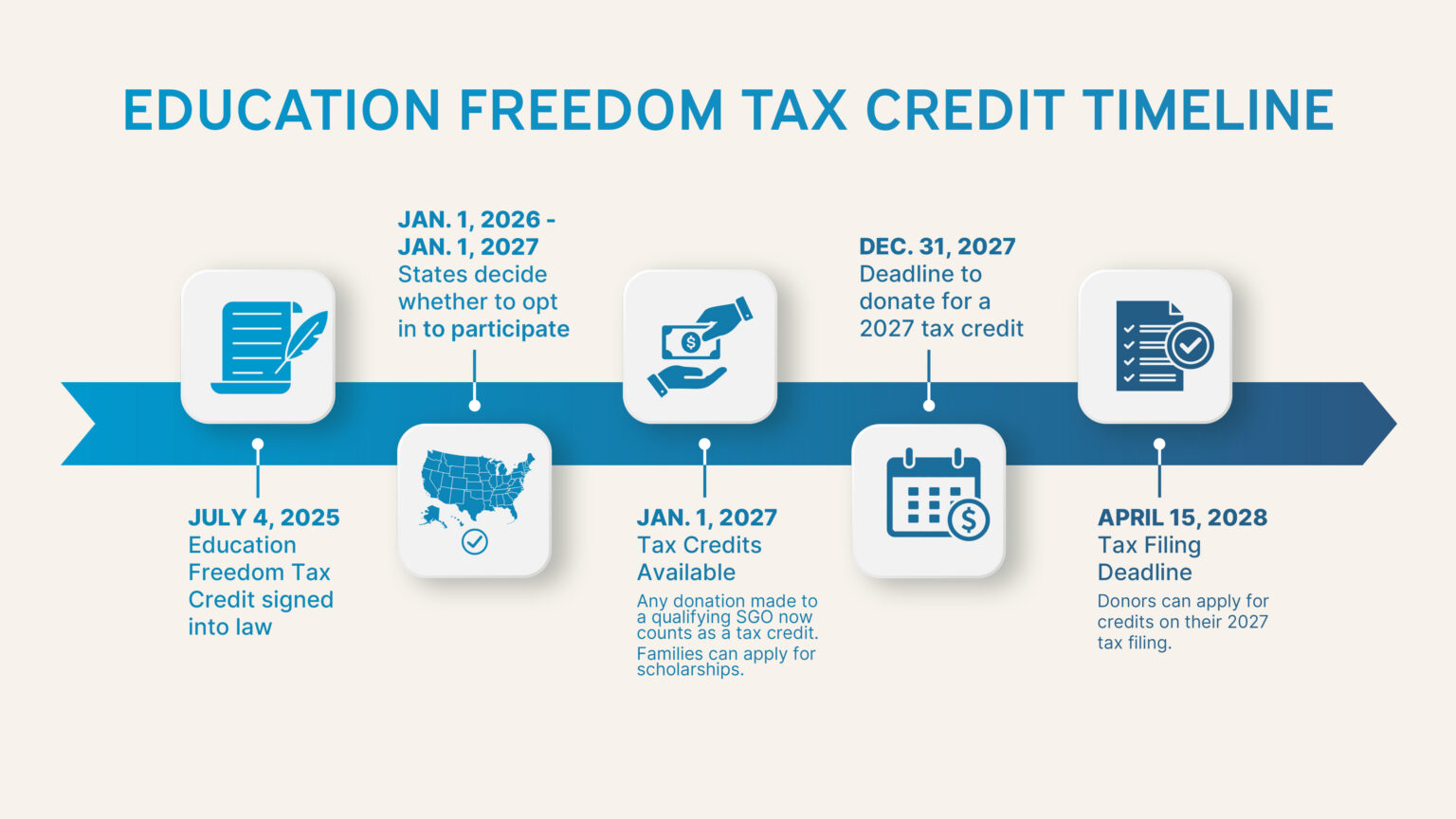
The visual below maps out the complete donor journey from the moment you give to the moment the credit posts on your return. The timeline is straightforward — the key is knowing which actions fall in 2027 (your donation) versus which fall in 2028 (your filing).
The Part Most Donors Don’t Realize
The EFTC has two layers of tax benefit — and most donors only hear about one of them.
Layer 1: The tax credit. The first $1,700 of your annual SGO donation qualifies for a 100% federal tax credit. A credit is not the same as a deduction. A $1,700 deduction for someone in the 22% tax bracket saves them $374. A $1,700 credit saves them $1,700 — the entire amount comes straight off their tax bill.
Layer 2: The charitable deduction. You can donate up to $10,000 to a qualified SGO in a single year. Everything above the $1,700 credit threshold — up to $8,300 more — is treated exactly like any other 501(c)(3) charitable donation: it’s tax-deductible. So a donor who gives $10,000 receives $1,700 back as a federal tax credit, and may also deduct the remaining $8,300 as a charitable contribution on their itemized return.
This combination makes the EFTC one of the most compelling philanthropic giving structures in the U.S. tax code — and the students who receive scholarships funded by your gift benefit immediately, regardless of which tax advantage applies to you.
Get notified when the Education Freedom Tax Credit launches so you don’t miss the opportunity to support K–12 students while benefiting from a federal tax credit.
Frequently Asked Questions
When can I start donating to receive the EFTC?
The Education Freedom Tax Credit takes effect January 1, 2027. Donations made to qualified Scholarship Granting Organizations (SGOs) on or after that date are eligible for the tax benefits. The first $1,700 of your annual donation qualifies for a 100% federal tax credit; amounts above that (up to $10,000 total) are deductible as a standard 501(c)(3) charitable contribution.
How long does it take for a student to receive a scholarship after I donate?
Timelines vary by SGO, but most scholarship-granting organizations award and disburse scholarships within a few weeks to a couple of months of receiving a donation. Your contribution is pooled with other donations to fund scholarships on a rolling basis.
What tax documentation will my SGO send me?
Your SGO is required to issue you a written contribution acknowledgment — similar to a charitable gift receipt — confirming the amount donated and the date. Keep this document; you will need it when you file your federal tax return to claim the Education Freedom Tax Credit.
Do I have to donate to an SGO in my own state?
No. The EFTC is a federal tax credit, so you can donate to any qualified SGO operating in any state and still claim the credit on your federal return. You should confirm the organization is a federally qualified SGO before donating.
Can I choose which school receives the scholarship funded by my donation?
Each SGO has its own policies. Some allow donors to designate a general geographic area or school type; others assign scholarships based on student applications and demonstrated financial need. Review your SGO’s policies before donating if school selection is important to you.
What happens if I donate more than $1,700?
Great news — you can donate up to $10,000 to a qualified SGO in a single year and still benefit on your taxes. The first $1,700 qualifies for the 100% federal tax credit (dollar-for-dollar off your tax bill). The remaining amount — up to $8,300 more — is treated as a standard charitable deduction for a 501(c)(3) nonprofit, the same way any other qualifying charitable gift would be handled. Your tax professional can help you calculate the combined benefit based on your income and whether you itemize deductions.
Disclaimer: This article is for informational and educational purposes only and does not constitute tax, legal, or financial advice. Tax laws are subject to change. Please consult a qualified tax professional regarding your individual circumstances. The Education Freedom Tax Credit is effective January 1, 2027. Contribution limits and program details are subject to IRS guidance and final program rules.