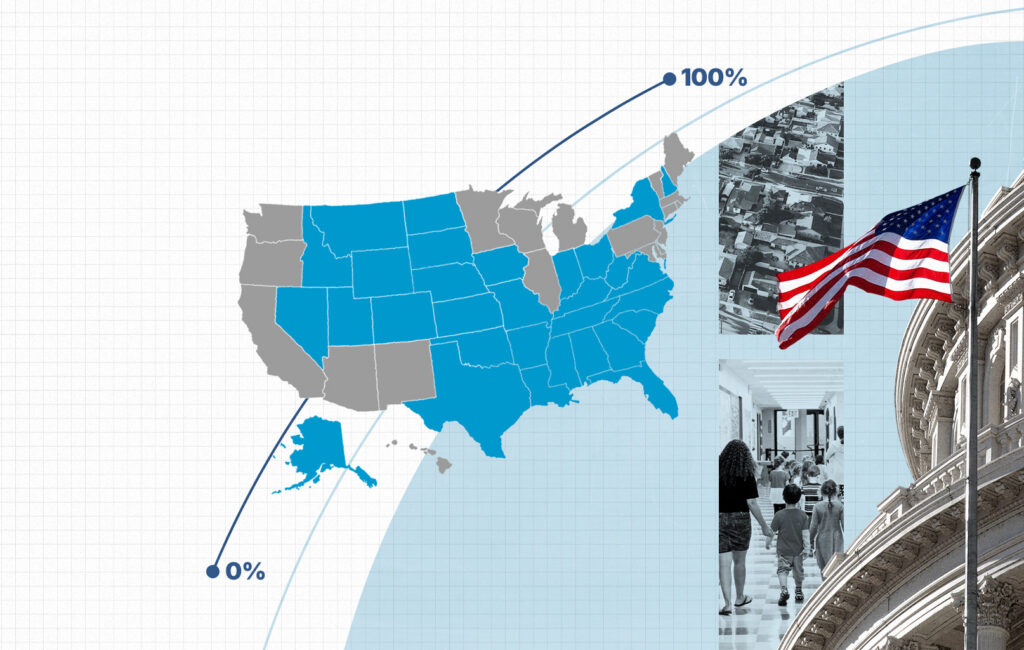
One year ago, not a single state had signed up for the Education Freedom Tax Credit. Today, 30 are on the map and the story of how they got there involves midnight signatures, three veto overrides, and a few political conversions nobody saw coming.
On September 29, 2025, Nebraska Governor Jim Pillen signed Executive Order 25-14 and committed his state to a federal scholarship program that, strictly speaking, did not yet have a sign-up sheet. The IRS would not publish the form states use to opt in for another ten weeks. Pillen signed anyway. Nebraska wanted to be first, and it was.
It was an odd way to start a national movement with a governor filing paperwork before the paperwork existed. But it set the tone for what followed: a twelve-month land rush that has redrawn the education map faster than almost anyone predicted. When President Trump signed the Education Freedom Tax Credit into law on July 4, 2025, as part of the One Big Beautiful Bill Act, zero states were in.
One year later, 30 are on the participation map, and the first dollar-for-dollar donations — up to $1,700 per taxpayer, every dollar of it funding K–12 scholarships — are less than six months away.
The First Domino
Virginia made it official first. Days before leaving office in January 2026, Governor Glenn Youngkin completed the formal federal election, making Virginia the first state fully in — and handing to his Democratic successor, Abigail Spanberger.
Then came National School Choice Week, and the dam broke. In the last two weeks of January alone, governors in New Hampshire, Oklahoma, Utah, Florida, South Carolina, Alabama, Arkansas, Mississippi, Indiana, Montana, Georgia, Nevada, North Dakota, and Alaska all said yes. Some signed executive orders. Some simply filed the IRS’s new Form 15714 and announced it after the fact. Georgia’s Brian Kemp signed the election at his desk and told the Capitol press days later. Oklahoma’s Kevin Stitt paired his order with a directive to build a statewide School Choice Hub within 90 days.
The Conversions
The more surprising storyline was unfolding in blue states. Colorado’s Jared Polis, a Democrat and former public-school entrepreneur, had already opted in back in December 2025, telling the Colorado Sun he would “be crazy not to” take federal money for Colorado families. He called it a “no-brainer.”
In May, New York’s Kathy Hochul followed, folding participation into her executive budget proposal.
Their logic was less ideological than arithmetic. The credit doesn’t spend a state’s own money; it lets a state’s residents redirect federal taxes they already owe into scholarships for local children. A state that opts in keeps those dollars home. A state that doesn’t is, in effect, donating them to children in the state next door.
Be the First to Know
Get notified when the Education Freedom Tax Credit launches so you don’t miss the opportunity to support K–12 students while benefiting from a federal tax credit.
The Showdowns
Not every governor was persuaded, and in three states the legislature simply went around them. Kentucky’s Andy Beshear vetoed his state’s opt-in bill; the legislature overrode him on March 17. Kansas’s Laura Kelly vetoed hers in April; the House overrode 85–38, the Senate 29–10. North Carolina’s Josh Stein made it three: the House overrode his veto 73–46 in May, and on June 3 the Senate finished the job, 30–19. What began as a one-off became a recognizable route into the program — and a signal of how much legislative muscle sits behind it.
Stein’s response afterward may be the most interesting political document of the year: rather than keep fighting, the Democratic governor announced he wants to help North Carolinians steer their donations toward scholarship organizations that serve public-school students. If you can’t stop the river, dig your own channel.
The Holdouts
Elsewhere the door stayed shut for now.
Arizona’s Katie Hobbs vetoed opt-in bills twice, in January and April. Wisconsin’s Tony Evers vetoed his in March. Minnesota’s Tim Walz said participation was “never going to happen.” Oregon’s Tina Kotek reconsidered, then declined. Rhode Island went furthest, enacting a first-in-the-nation law requiring both the legislature and the governor to approve any future opt-in.
And a broad middle remains genuinely undecided: Pennsylvania, Illinois, Michigan, Massachusetts, New Jersey, Connecticut, California among them are states where coalitions are forming, op-eds are flying, and governors are watching Treasury’s September regulations before they move. In Massachusetts, a coalition of 124 organizations launched in May to press Governor Maura Healey. In California, more than a thousand students at one Los Angeles-area parochial school mailed 15,000 postcards to Governor Newsom.
What the Map Means for You
For donors and families, the takeaway is simple and personal: whether the Education Freedom Tax Credit reaches your community in January depends on a decision being made (or not made) in your state capitol right now.
If your state is in, your $1,700 donation next year can fund a scholarship for a child in your own community, at no net cost to you. If it isn’t yet, the map says one thing clearly: this year, pressure works.
The AFC Scholarship Fund is preparing to serve donors and families in participating states nationwide the moment the program goes live on January 1, 2027.
As of July 2026, 30 states are on the participation map. The IRS’s official roster lists 28 completed elections, with Kansas and Kentucky in by legislative action but still completing their federal filings.
Nebraska was first to commit, by executive order in September 2025. Virginia was the first to complete the formal federal election, in January 2026.
Yes. Colorado’s Jared Polis opted in first, calling it a “no-brainer,” and New York’s Kathy Hochul announced her state’s participation in May 2026.
Donors in non-participating states cannot direct their federal taxes to scholarships for local children — those dollars effectively flow to families in participating states instead. States can still opt in ahead of the January 1, 2027 launch.