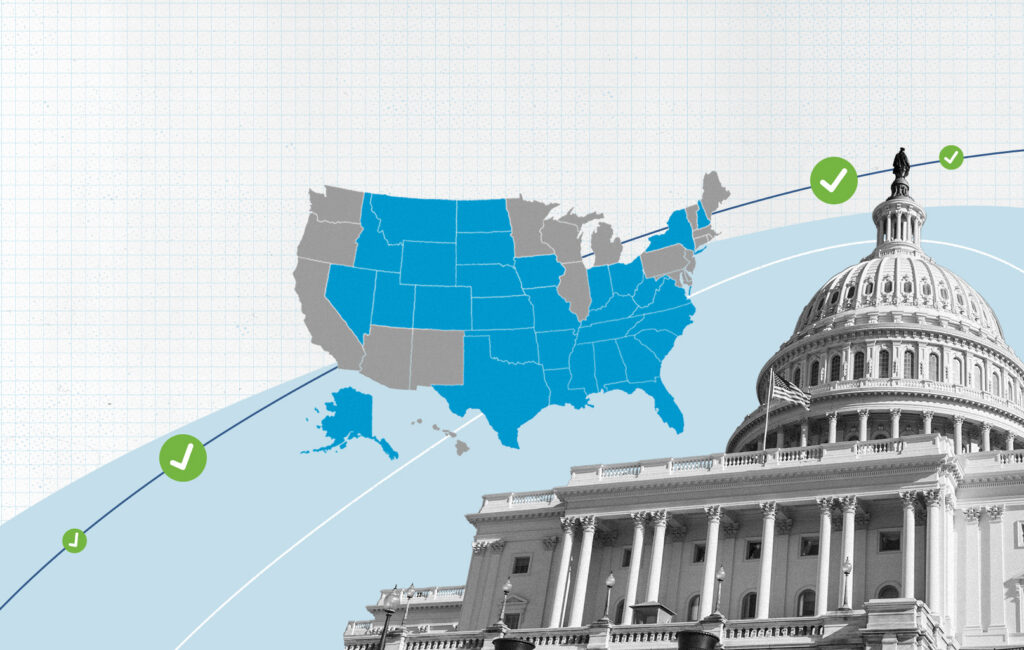
The Education Freedom Tax Credit (EFTC) is a federal tax credit, but its scholarships only reach families in states whose governor chooses to participate. Understanding how that decision gets made, and what happens when a state declines, matters for anyone advocating for kids in their community.
The mechanism
By January 1 of each year (a later, separate deadline applies for the credit’s first year, 2027), a participating state’s governor, or another state-designated authority, must submit to the U.S. Treasury a list of Scholarship Granting Organizations (SGOs) in that state that meet the federal requirements. Without that submission, no organizations in the state are designated, and scholarships effectively do not flow there for the year. States have also been able to file an advance election since January 2026, a way to formally signal 2027 participation ahead of submitting the full SGO list.
Two paths to participation
In some states, the governor acts through existing executive authority to certify a process and submit qualifying organizations directly. In others, the legislature passes a bill establishing a state-level framework, additional oversight, reporting requirements, an application process, that the governor then signs or vetoes. Either path can lead to participation, and the two can also collide: several legislatures have passed opt-in bills that governors have vetoed, leaving a state’s status pending or contested.
Participation is decided every single year
A state that doesn’t opt in this year remains free to opt in next year, and a state that participates this year could choose to step back in a future year. A gubernatorial veto in one year doesn’t permanently close the door; it can be reversed by that governor later, overridden by the legislature, or revisited under new leadership.
Be the First to Know
Get notified when the Education Freedom Tax Credit launches so you don’t miss the opportunity to support K–12 students while benefiting from a federal tax credit.
What happens when a state doesn’t opt in
Families in that state cannot access scholarships funded through this tax credit, since no SGOs are designated there. Their state effectively forfeits federal support that would otherwise flow to local students, without any corresponding effect on the state’s own budget, since this credit is entirely federally funded. Meanwhile, and this is the detail that deserves the most attention, residents of that state can still claim the federal credit personally, by donating to a qualifying SGO, like AFC Scholarship Fund, in a state that has opted in. Their donation, and the credit that comes with it, simply supports a student somewhere else instead of at home.
The scale of what’s at stake is real. If, for illustration, 100,000 residents of a non-participating state each claimed the full $1,700 individual credit by giving to out-of-state organizations, that would represent more than $170 million in donations (and more, since married couples filing jointly can claim up to $3,400), and the local scholarships they could have funded, leaving the state instead of staying in it. In a larger state, the annual total at stake could run considerably higher.
Opting in costs the state nothing
Because the credit and the scholarships it funds are entirely federal, there is no state appropriation involved and no impact on state education budgets. A state’s role is limited to the administrative act of electing to participate and submitting its list of qualifying organizations to Treasury each year.
How constituents can make their voice heard
Direct outreach to the governor’s office, testimony at legislative hearings, letters to local media, and coordinated advocacy through community and parent organizations all factor into how these decisions get made. This is a genuinely responsive political process, and constituent voice counts in both directions.
The governor, or another state-designated authority, submits the state’s annual list of qualifying scholarship organizations to the U.S. Treasury. In some states, the legislature passes an opt-in bill that the governor then signs or vetoes.
Yes. The credit is federal, so any eligible taxpayer can claim it regardless of their state’s participation, by donating to a qualifying SGO in a state that has opted in. The scholarship your gift funds will support a student in that other state, not your own.
No. The credit and the scholarships are funded entirely at the federal level. A state’s role is limited to electing to participate and submitting its list of qualifying organizations, an administrative step, not new spending.
Yes. Participation is decided annually, so a state that sits out one year can join in a future year, and the reverse is also true.