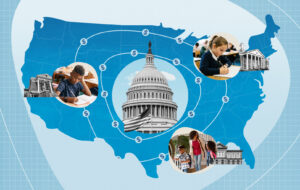
A donor in one state can claim the Education Freedom Tax Credit next year whether or not that state joins the program. The scholarship that donation funds, though, would go to a child somewhere else. That single detail explains why some states are now facing the same question, and why the answer resets every January.
A Credit That Follows the Scholarship, Not the Donor
Here is the fact that surprises most people when they first learn how the Education Freedom Tax Credit (EFTC) is written: a donor’s home state does not determine whether the donor can claim the credit.
Starting January 1, 2027, an eligible taxpayer may claim a dollar-for-dollar federal tax credit of up to $1,700 for a qualified contribution to a certified Scholarship Granting Organization (SGO), like AFC Scholarship Fund. A SGO is a nonprofit that collects donations and awards K-12 scholarships to students.
The catch is where the money lands. The credit follows the SGO’s state of operation, not the donor’s address. If a state has not opted in, it has no certified SGOs, and its residents who give can only give to organizations serving students elsewhere.
So the cost of waiting is not measured in lost tax credits. It is measured in scholarships that get awarded in another state’s classrooms.
Where the Decision Stands Now
New York announced it was moving toward participation on May 8, 2026, adding to a list that has grown steadily since the EFTC became law on July 4, 2025 as part of the One Big Beautiful Bill Act.
A handful of states remain undecided. Several are among the country’s most populous: Pennsylvania, New Jersey, Illinois, Michigan, Massachusetts, Maryland, California and Washington among them.
Under the statute, a state’s participation runs through the governor, who submits a list of qualifying scholarship organizations to the U.S. Treasury Department. No list, no certified SGOs, no in-state scholarships.
Why Supporters and Skeptics See the Same Facts Differently
Supporters of opting in make an argument that is closer to arithmetic than ideology. The credit does not spend state money. It gives residents a federal tax credit for a charitable gift, and a state that participates keeps the resulting scholarships within its own borders.
Governors who have declined or delayed have generally raised different concerns: the effect on public school systems, the absence of final federal regulations, and questions about how eligibility and oversight will work in practice.
What has changed the conversation in some capitals is timing. Treasury’s regulations are still being finalized, which gives a cautious governor a reason to wait and gives an eager one a reason to prepare.
Both positions can be held in good faith. The facts on the page are not really in dispute; what differs is which consequences a governor weighs most heavily.
The Decision Comes Back Every Year
This is the detail that gets lost in coverage of holdout states, and it may be the most useful thing to understand.
Be the First to Know
Get notified when the Education Freedom Tax Credit launches so you don’t miss the opportunity to support K–12 students while benefiting from a federal tax credit.
The opt-in is annual. A governor who declines to submit a list for 2027 can submit one in 2028, or any year after that.
That means the cost of sitting out is bounded by a single program year at a time. It also means it compounds for as long as a state stays out.
The practical effect? A state that joins late does not lose the program. It loses the years it missed.
What This Means If You Live in an Undecided State
If you are a taxpayer in a pending state, here’s what you need to know.
You may still be able to claim the EFTC beginning in 2027 by giving to a certified SGO in a participating state, subject to final Treasury rules. The scholarship your gift funds would support a student there, not at home. And your state can still change that before January 1, 2027.
If you are a parent, the eligibility rules are worth knowing now. Under the statute, students in households at or below 300% of the relevant area median gross income may qualify, and scholarship funds can cover tuition along with tutoring, educational therapies, testing fees and educational software.
The credit is non-refundable, which means it reduces federal income tax liability and does not produce a payment beyond what a taxpayer owes. The sequence matters too: the charitable contribution comes first, and the credit is claimed later, at filing.
Where AFC Scholarship Fits In
Our interest in this map is practical: we are preparing to serve donors and families in participating states when the program opens on January 1, 2027.
We do not decide which states opt in, and we do not control Treasury guidance or IRS policy. What we can do is explain the rules plainly as they are written and update our reporting when they change.
If you want to see how the mechanics work, our step-by-step explanation of the EFTC walks through the sequence, and our guide to how states opt in covers the governor’s submission process in detail.
What to Watch Next
Three things will shape the next few months. Final Treasury regulations, which several governors have said they are waiting on. Any announcement from the remaining states before the end of 2026. And the first round of state SGO certifications, which determine where scholarships can actually be awarded.
Legislatures matter here too. In some states, lawmakers have moved opt-in bills independently of the governor’s office, and those routes are still open.
If you want to know where your state stands and what happens next, sign up for updates and we will send you the facts as they are confirmed.
Based on the statute as written, eligibility for the credit follows the scholarship granting organization's state of operation, not the donor's residence. An eligible taxpayer in a non-participating state may still be able to claim the credit by giving to a certified SGO in a participating state, subject to final Treasury rules. The scholarships funded by that gift would go to students in the participating state.
Participation runs on an annual cycle through the governor's submission of qualifying scholarship organizations to the Treasury Department. A state that does not participate for the program's first year, which begins January 1, 2027, may submit a list in a later year.
Under 26 U.S.C. §25F, eligible students are those in households at or below 300% of the relevant area median gross income. Funds can support tuition and other educational expenses including tutoring, educational therapies, testing fees and educational software, subject to final federal and state rules.
No. They come from a model published by an advocacy organization, with participation assumptions the tool discloses. They should be read as illustrative scenarios, not as Treasury or IRS forecasts.