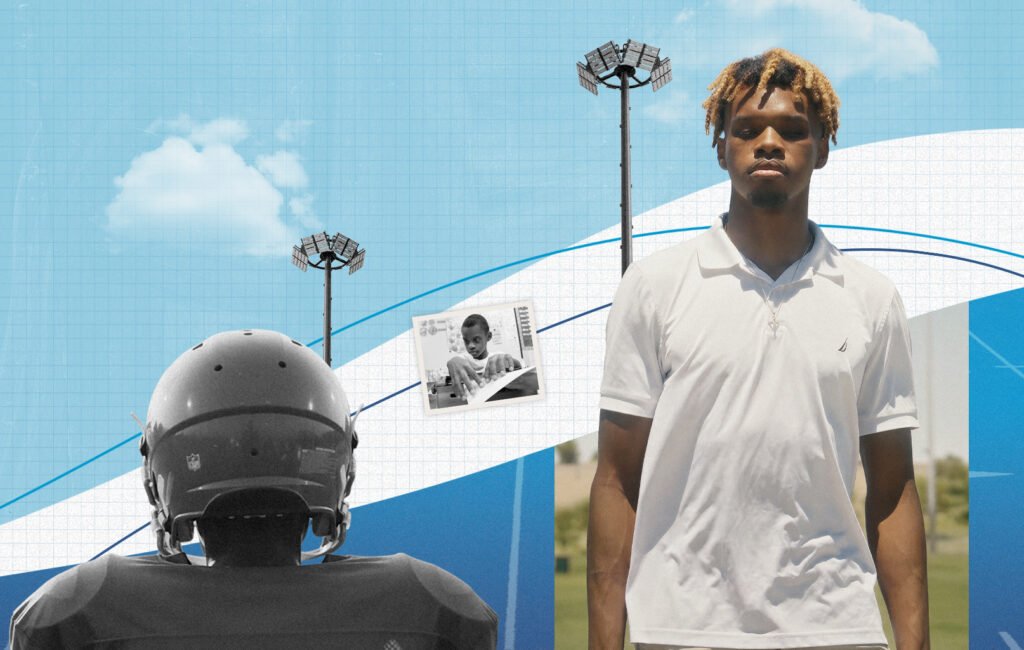
Every parent imagines the world their child is going to grow up in. For Adonis’s parents, that picture changed overnight, on an ordinary Sunday at the pool, the day before their son’s first football practice.
A Sunday That Changed Everything
At five years old, Adonis was swimming with his family, having the kind of afternoon most kids have a hundred of. He went underwater, came back up, and everything was different.
“Everything around me was very cloudy,” he says. “I’ve been blind ever since.”
The timing made it harder to process. The family had just picked up his first pair of football cleats. He was supposed to start practice the very next day.
At first, his mother didn’t want to believe what she was seeing. “I think I was in denial,” she says. “I just thought, ‘No, his vision will come back.’”
Doctors diagnosed Adonis with congenital glaucoma, a condition typically caught in a child’s first year or two of life, not something that shows up, seemingly out of nowhere, at five. His first year of blindness led to 10 corrective eye surgeries.
“I’m Blind. I’m Not Sick.”
But somewhere in that first hard year, Adonis found the words that would define how his family talked about his blindness from then on. At just seven years old, he turned to his mother and told her plainly.
“Mom, I’m blind. I’m not sick. Being blind does not hurt. It hurts you, but it doesn’t hurt me,” Adonis said.
His mother has carried her son’s words with her ever since.
And Adonis backed it up with how he lived; within days he was back outside in the neighborhood, playing football with his older brother and the older kids like nothing had changed.
“I’ve never had a moment where I felt defeated,” he says.
Back on the Field
When Adonis told his parents he still wanted to play organized football, his dad figured it was a phase.
“I thought, ‘Oh, he’ll forget about it,’” he says. “But he didn’t.”
So his dad got creative. At the time, the NFL had started wiring quarterback and middle-linebacker helmets with speakers so players could hear play calls from the sideline. Adonis’s dad borrowed the idea, grabbed a walkie-talkie from Radio Shack, and taped it inside his son’s helmet himself.
It worked.
“I played video games all my life, too,” his dad says. “So it’s kind of like playing a video game in real life.”
He braced for the worst at Adonis’s first practice, almost certain his son would take one hard hit and want to quit.
Instead, Adonis got hit hard, got up, and kept playing.
“Everybody was laughing and hugging me, asking me, ‘Please come back. He’s amazing. He’s the fastest runner on the team,’” Adonis recalled.
Adonis learned to read the game by sound instead of sight. “Once I’m lined up, those linemen are going to be there. I know where the quarterback’s going to be at ’cuz I can hear him,” he says. “As long as I take my steps correctly and just get the ball, everything else will figure itself out.”
Be the First to Know
Get notified when the Education Freedom Tax Credit launches so you don’t miss the opportunity to support K–12 students while benefiting from a federal tax credit.
The Scholarship That Opened Brophy’s Doors
By the time Adonis reached high school, a family friend pointed his parents toward Brophy College Preparatory, one of the top high schools in the nation.
It felt like a different world entirely.
“Brophy was like a whole different community, a whole different world to us,” Adonis’ mother says.
It was also $15,000 a year, a number that didn’t fit the family’s budget. Then Adonis’s mom found Arizona’s Empowerment Scholarship Account (ESA) program, which let the family redirect education funding toward the school built to give her son what he needed.
“My mom found out about the Arizona ESA scholarship, and I was able to go to the school with the best resources for me,” Adonis says.
“Going to Brophy allowed me to expand my view of people, as well as gave me resources to elevate myself academically and physically.”
At Brophy, Adonis became a four-sport athlete in basketball, football, wrestling, and track and field, abilities his mother said many never expected.
“It’s almost like he’s not blind. It’s like the world is blind to his abilities. At Brophy, they expect more, above and beyond,” she said.
“Brophy put me in a position where I had the support, but I was challenged at the same time,” Adonis says.
Adonis Today
Adonis is candid about the perspective his five years of sight gave him.
“I realize I’ve had it better than other people who’ve gone blind, because I had five years of sight,” he says.
“I remember what simple things like the sky and the sun look like. I remember what a football field looks like.”
He has since won races in track. He has scored touchdowns. He graduated high school, and this year, he finished his undergraduate degree. Now he’s headed toward a master’s.
Adonis says credits his bright future to the fact that his family had the choice to send him to the school that was best for him.
What Adonis’s Story Makes Clear
Adonis’s family found their answer through Arizona’s ESA program, one of the most expansive school choice programs in the country. But that kind of flexibility doesn’t exist everywhere, and not every family raising a child with a disability lives somewhere they can access it.
The Education Freedom Tax Credit (EFTC), launching in 2027, is designed to close that gap on a national scale. When eligible donors give to a qualified Scholarship Granting Organization (SGO), they receive a dollar-for-dollar federal tax credit: up to $1,700 for individuals, or up to $3,400 for married couples filing jointly. You give first; the credit reduces your federal tax bill when you file. The credit is the entry point, not the limit. You can give more, and the amount above the credit is treated like any other charitable contribution under the usual tax rules.
A national scholarship infrastructure means a family’s zip code shouldn’t determine whether their child gets access to a school built to challenge and support them the way Brophy did for Adonis.
Adonis’s parents advocated, adapted, and found a way forward. A scholarship helped close the financial gap standing between their son and the school built for him. Donors make that scholarship possible, and the EFTC makes the donors possible, for every Adonis still waiting for his shot.
Countless families have a story like this one. See more stories of students and families whose lives changed through school choice.