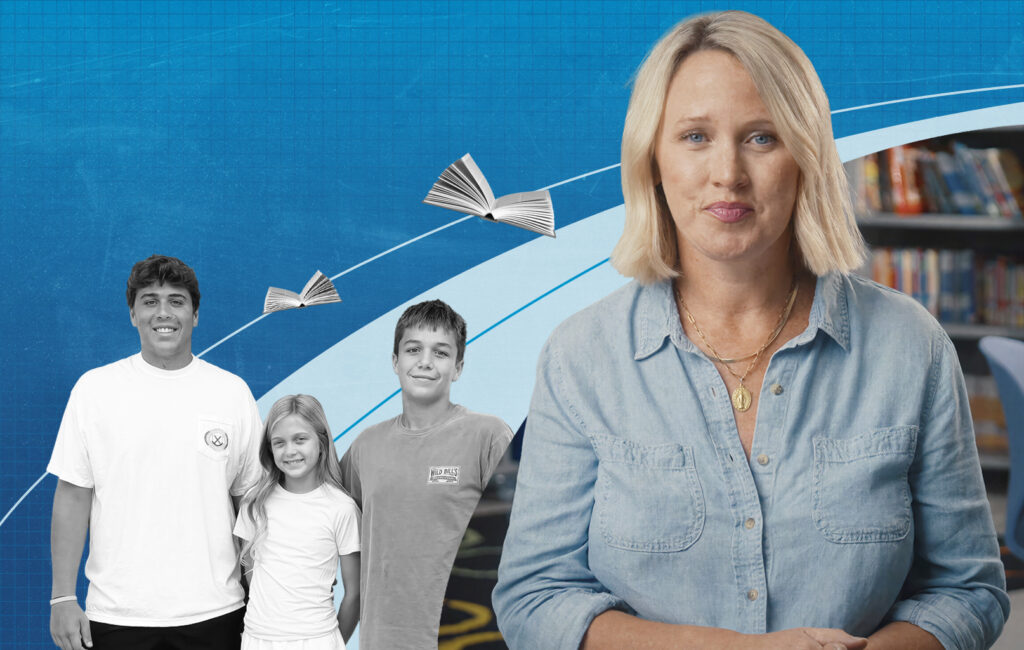
“God blessed me with three children with dyslexia.”
That’s how Leah Feretti, a K-12 teacher and mother of three in Mississippi, begins her family’s story. Today her oldest son is thriving. Getting there took more than anyone should have to give.
There was no dyslexia therapist anywhere in her region of the state. The school couldn’t help. “I had to invent my own version of school choice to get my children the education they needed,” Leah said.
A Second Year of Kindergarten
Her journey began more than a decade ago. Leah’s oldest son, Thomas, was in his second year of kindergarten when his teacher, a close friend of Leah’s, pulled her aside and suggested they have Thomas tested for a learning disability.
Leah and her husband took two days off work while Thomas went through a full battery of tests. The results came back: Thomas was severely dyslexic, and his dyslexia had brought on severe anxiety.
Suddenly, everything made sense. Thomas hated going to school. He cried every single day. His stomach hurt.
“I would just look around and see all the other students speeding through the tests and classwork,” Thomas remembered.
“And I’d just sit there not understanding the words.”
“We Do Not Offer This Service”
Thomas needed Orton-Gillingham-based dyslexia therapy, a structured approach to teaching reading. Leah took his diagnosis to the school, confident they would give him what he needed.
But they couldn’t.
The school didn’t offer the service, and there wasn’t a dyslexia therapist anywhere in their region of the state.
Leah’s first thought was to move. Sell the house, sell the business, and go wherever Thomas could get help.
Her husband stopped her. “Hold on, honey,” he said. “Pump the brakes.”
They had built their family business from scratch. Packing up and leaving meant walking away from their livelihood with no other job waiting.
The Lesser of Two Evils
But Leah didn’t give up and kept researching. She found that Mississippi College offered a master’s degree in dyslexia therapy, and she brought a new idea to her husband.
What if she took out a student loan, went back to school, and became Thomas’s therapist herself?
“That’s an awful idea as well,” Leah admitted.
“But if that’s the lesser of the two evils, we didn’t have a choice but for me to go back to school and get this degree just to help my son.”
Around the same time, Mississippi passed its first small step toward school choice: an education scholarship account (ESA) for students with special needs.
For the Ferettis, it meant something simple. “It allowed us flexibility and freedom,” Leah said.
Looking back, she doesn’t see any of it as an accident.
“There’s no doubt within my heart or in my mind that this was the trajectory that God set our family on and the path that He put before us.” she said.
A Mom Who Fought for Every Kid
Leah didn’t stop with her own son. Once she was trained, she brought that same help to other students at Thomas’s school.
“My mom really fought for me,” Thomas said.
“And not only did she do it with me, but she did it with multiple other kids in the school, and it really helped everybody out.”
Thomas Today
Today the Ferretti’s live in a different part of Mississippi. And where do Leah’s children go to school?
Be the First to Know
Get notified when the Education Freedom Tax Credit launches so you don’t miss the opportunity to support K–12 students while benefiting from a federal tax credit.
“Guess what?” she said. “In a public school.”
For Leah, that’s the point. “School choice is not anti-public school. It’s about choosing the school that’s the right fit.” Because Thomas got the support he needed early on, public school is the right place for him now.
The boy who cried before school every day is now succeeding in the classroom. He’s carrying that success onto the football field, and he has grown into a leader.
“I’m so proud of him,” Leah said.
“He’s the victory. He is proof of why we need school choice. He’s proof of why we need ESAs.”
What Leah’s Story Makes Clear
Leah’s family found their way through a master’s degree, a student loan and Mississippi’s special needs ESA. But most parents can’t go back to school to become their child’s therapist. And they shouldn’t have to.
“A mother should not have to go back to school to give their children an education,” Leah said.
The Education Freedom Tax Credit (EFTC), launching in 2027, is designed to help more families find the right fit, no matter where they live. When eligible donors give to a qualified Scholarship Granting Organization (SGO), like AFC Scholarship Fund, they receive a dollar-for-dollar federal tax credit: up to $1,700 for individuals, or up to $3,400 for married couples filing jointly. You give first; the credit reduces your federal tax bill when you file. The credit is the entry point, not the limit. You can give more, and the amount above the credit is treated like any other charitable contribution under the usual tax rules.
A national scholarship network means a child like Thomas doesn’t have to wait for his mom to earn a degree before he gets the help he needs.
“School choice is important to me because it saved my family,” Leah said.
“It saved my children. All children deserve that.”
Countless families have a story like this one. See more stories of students and families whose lives changed through school choice.