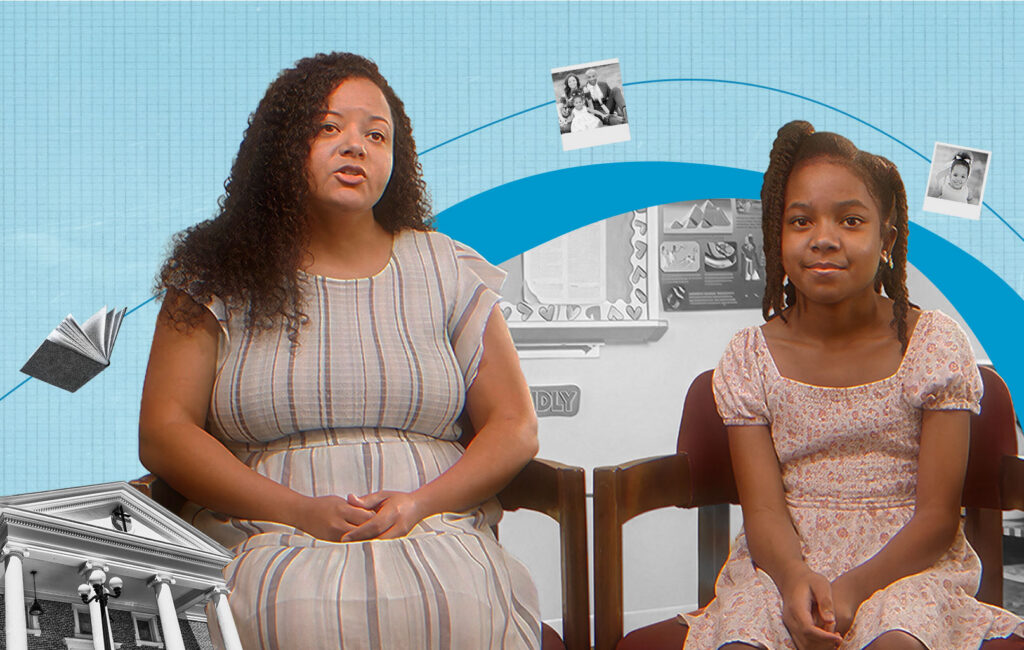
“School choice was pretty much limited to where you lived.”
That’s how Whitney Jordan sums up the years she spent searching for a school for her daughter, Reagan. “It had nothing really to do with the education and what the school provided.”
Whitney served eight years in the Army. Her husband served 23. The Army sent them to San Antonio, and that assignment shaped their family’s life long after both of their careers ended.
Starting a Family After Service
After they left the Army, Whitney and her husband both went back to school and earned their bachelor’s degrees. Then they started a family.
Reagan was diagnosed with autism at two and a half. She went through therapies until kindergarten.
When it came time for school, Whitney knew what she was looking for. “I wanted specifically a school that was dedicated to autism,” she said. “I wanted to make sure there was a foundation to where she could grow.”
Too Advanced for Her School
Reagan’s school in San Antonio wasn’t working. She was too advanced for it, and the school told the family as much.
“They said, you know, this really isn’t the right place for her,” Whitney said.
With nowhere else to turn, Whitney homeschooled Reagan for the rest of first grade and all of second grade. “I didn’t feel like there was a program out there,” she said.
At the time, the options Reagan needed weren’t available close to home. North Carolina had what the Jordans needed: a school built for kids like Reagan, and a scholarship to help pay for it.
Two Years on a Waitlist
That school was School of Hope, an all-autism school in North Carolina. The Jordans spent two years on its waitlist. Then they made the decision to leave Texas and move.
As soon as they arrived in North Carolina, Whitney applied for a scholarship.
“When we got the call saying we got in, it was just like a thank you Jesus moment,” she said. “I wish I had more words to describe just the weight that is lifted from us financially.”
Be the First to Know
Get notified when the Education Freedom Tax Credit launches so you don’t miss the opportunity to support K–12 students while benefiting from a federal tax credit.
“You Are Safe and You Are Loved”
Whitney could feel the difference from her first visit.
“When I came here to do the tour, you could tell that the teachers and the school put in a lot of effort for our kids, and the belief in our kids was here,” she said. “It mattered. And they believed that our kids could do more than what the outside world told us they would ultimately become.”
A couple of weeks after Reagan started, Whitney heard one of the teachers speak to another student.
“You are safe and you are loved.”
“Then I knew Reagan was in the right spot,” Whitney said. “I knew it. I knew it from day one.”
Today, Reagan loves going to school every day. She loves her classmates. “We don’t have to worry about bullying,” Whitney said.
So what’s the best thing about School of Hope?
“Um, everything.”
A Great School Shouldn’t Require a Moving Truck
The Jordans found the school Reagan needed. But they had to change states to get there, and not every family can do that.
“I think the Education Freedom Tax Credit is a great idea,” Whitney said. “It’s going to benefit our families. It’s going to benefit our military families.”
Launching in 2027, the Education Freedom Tax Credit (EFTC) lets eligible donors help fund K-12 scholarships for families like the Jordans. Give to a qualified Scholarship Granting Organization (SGO), like AFC Scholarship Fund, and receive a dollar-for-dollar federal tax credit: up to $1,700 for individuals, or up to $3,400 for married couples filing jointly. You give first; the credit reduces your federal tax bill when you file. Want to do more? Give above the credit amount, and the extra is treated like any other charitable contribution under the usual tax rules.
Because it’s a federal tax credit, families in every participating state can benefit. That means fewer families have to pack up and move just to find a school that works for their child.
Whitney sees what that could mean for families like hers. “It’s going to help us have free choice in where we want to put our kids, because that’s what we’re battling,” she said. “Military families need accessibility to great education.”
Reagan’s family had to cross state lines to find hope. The next family shouldn’t have to. Read more stories of families who found their school through school choice.