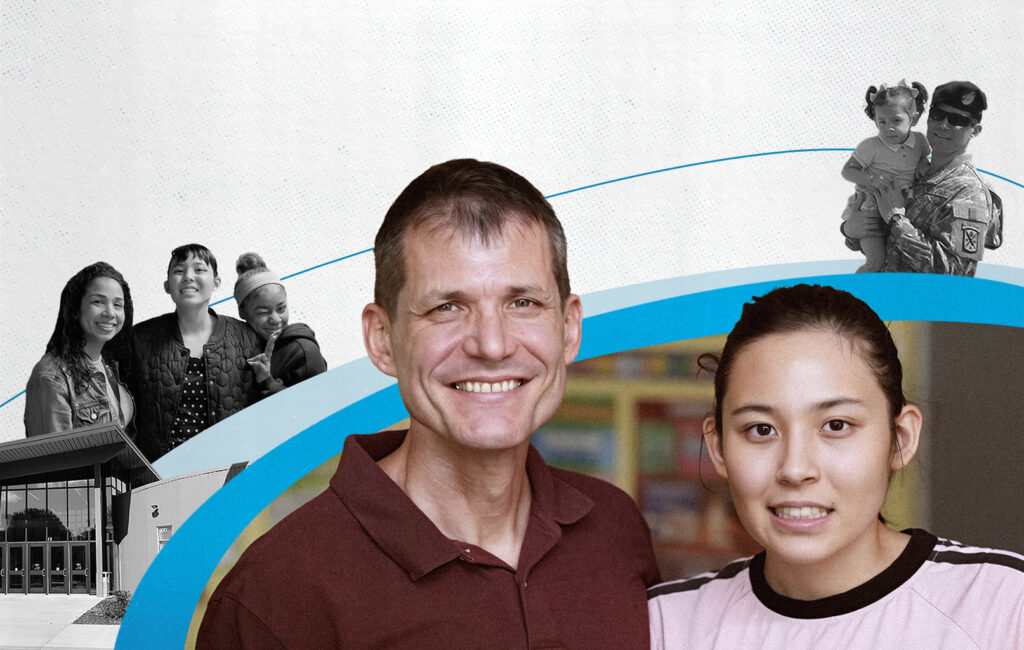
“She was pulling 12-hour days.”
That’s how James Martin, a retired Army combat veteran, describes the years before his daughter Mia found a school that understood her. James and his family settled in North Carolina at Fort Bragg in 2016. Mia was diagnosed with autism at three.
For four years, her days looked the same. Wake up at 5:30. Catch the special needs bus at 6:00. Arrive at school at 7:00. Get picked up around 1:00, then head to ABA therapy from 2:00 to 6:00. Home for a shower and dinner.
“And then rinse and repeat,” James said.
“Mia Had a Day”
Before the diagnosis, it felt like something was always going on.
“Every time I picked her up, it was, ‘Well, Mia had a day,’” James said. “And I’m like, ‘I know.’”
Mia was being aggressive. James brushed it off at first. “I’m like, ‘Well, girls need to be tough.’”
Then a staff member told him something he will never forget: “She is showing signs and symptoms of autism.”
“It was almost like a slap in the face,” James said. “I was like, ‘What is this autism?’”
“Our whole world changed after that diagnosis. It goes from being a disciplinary issue to a disability overnight.”
Outside the Circle
In the classroom, Mia was often on her own.
“She would be off doing her thing, and the other kids would be in a U-shape around the screen, learning,” James said.
He doesn’t blame the teachers. “You realize that it’s not that my daughter’s being intentionally sidelined. It’s just that they’re not prepared. They’re not able to deal with these behaviors.”
Every New Set of Orders Means a New School
For military families, school is never a one-time decision. Every PCS, or permanent change of station, means a move to a new duty station, and a new search for a school.
“The first question you ask is, what’s going to be there for my family?” James said. “What’s going to be there for my kids?”
Would there be a school choice option? Could Mia’s ABA team work with a private school? Could the family stay financially stable after the move, or would they have to fight to stay where they were?
“But then private school’s expensive, right?”
That’s when other parents told the Martins about North Carolina’s Opportunity Scholarship and ESA+ account for students with disabilities.
“It’s like, what are these things that you speak of?” James said.
So the family started hunting them down and applying. And School of Hope came onto their radar.
“Everybody’s on Team Autism Here”
School of Hope is an all-autism school.
“You don’t have to explain that to anybody that goes here,” James said. “Everybody gets it. Everybody’s on team autism here.”
The difference shows up in Mia.
“I don’t see as much of the behaviors, because she’s not tired and she’s not three different people in three different places,” James said. “She’s not Mia at school, Mia at clinic, and Mia at home.”
“She is just Mia. And everybody else is supporting that one person.”
James is clear about what made it possible. “A lot of that was made possible because of these grants and scholarships,” he said. “If it wasn’t, we wouldn’t have the funding to do it.”
What James’s Story Makes Clear
The Martins found their way through North Carolina’s scholarships, tips from other parents and a lot of searching. But military families don’t get to stay put. Every new set of orders can mean starting that search over in a new state, under new rules.
“What’s going to be there when I jump?” James asked. “What’s going to happen when I move from here to here?”
The Education Freedom Tax Credit (EFTC), launching in 2027, is a federal tax credit that can help more families afford private school and other education options. When eligible donors give to a qualified Scholarship Granting Organization (SGO), like AFC Scholarship Fund, they receive a dollar-for-dollar federal tax credit: up to $1,700 for individuals, or up to $3,400 for married couples filing jointly. You give first; the credit reduces your federal tax bill when you file. The credit is the entry point, not the limit. You can give more, and the amount above the credit is treated like any other charitable contribution under the usual tax rules.
States choose whether to participate. The more states that opt in, the less a military family has to wonder what will be waiting at the next duty station.
James sees it the same way. “It allows recipients to get the necessary financial support they need if they’re thinking about the private school option or options other than the public school system,” he said. “If it becomes nationwide, then you don’t have to worry as much.”
A national scholarship network means a child like Mia doesn’t have to start from scratch every time her family gets new orders.
“For special needs families, it’s important to have hope,” James said. “What this does provide us is the hope and the opportunity to do the best we can for her, education-wise, therapy-wise, while she’s young, while she’s malleable, while she’s able to adapt.”
“To hopefully give her the best possible life we could possibly give her.”
Countless families have a story like this one. See more stories of students and families whose lives changed through school choice.